Satellite radio subscribers are a rabid fan base. Even with both Sirius and XM finally merged, there is still subscriber programming preference. But what Satellite radio subscribers know for certain is that terrestrial radio is dead. Digital terrestrial radio will follow closely in it's footsteps without a steady revenue stream to procure new music. As beat down as Satellite radio is about all of the competition from iPods, and other portable music devices, I still believe that the average music listener is too lazy to either consistently update their music collection, or mix up their selections to stay fresh.
That is where Sirius XM excels--by providing the best on air talent, original content, and world class DJs. With all of this talk about the company not making it through 2009 because of a debt refinancing obligation due on February, what better way to ensure the survival of the company than a one time charge of $50 per subscriber, good towards any new radio or invoice in March of '09. Why refinance the 1 billion dollar debt when you can wipe the slate clean and get rid of standing inventory at the same time?
Sure, 50 bucks sounds like a lot of cash for a service that's supposed to be only 12 dollars a month. But, look at your cable bill, or cell phone bill, or a single fill-up at the gas station! Wouldn't you be willing to loan $50 to Sirius if it meant keeping all of the quality programming that you've grown accustomed to, and maybe even allow the company a bit of breathing room to come out with great new technologies and devices? Mel, you've got about 20 million subscribers that believe in what you're doing. If the banks are too gun shy, maybe you should try something a bit more unorthodox? After AIG, the government is not going to have much charity left for other companies depeding on reasonable lending practices for debt restructuring purposes. Power to the people!
Tuesday, September 16, 2008


Friday, September 12, 2008
Opinion: Bringing Excitement Back to the Sirius Brand...
In his Fool's post today, Rick Munarriz suggests a killer iPhone app so that Sirius subscribers don't have to cludge together some strange web-browser based streaming solution. Or my own, now outdated post describing a technique to hack the Sirius stream to run on the crippled Windows mobile platform. But to really get Sirius back in to the game it has to not just be able to deliver it's great content streams over the Internet, it has to deliver the Internet itself. Just think, if you're kids can enjoy streaming video to their seatbacks, why not Internet access? If Jet Blue can provide messaging service on Beta Blue while in-flight, why can't Sirius be an Internet Service Provider? With all of those extra channels available after the merger, it seems fitting that some be allocated to more sophisticated purposes than 24 hours of non-stop Jimmy Buffet.
Don't get me wrong, if I'm in the mood for some Buffet, the convenience of flipping over to channel 31 and getting my dosage is handy, but video like CNN, ESPN, or my own Slingbox, and email access would be better use of the wider spectrum. Now that the merger is complete, where the heck is the marketing? There are 18 million people out there that think the service and the content are good enough to put their hard earned dollars toward monthly, but the only thing the greater community knows is that the merger took a long time, the company isn't profitable, and they have huge debt obligations and stock dilution to deal with well in to 2009.
It's definitely time to shake things up and bring excitement back to the brand. Tap in to the fan base for ideas, and maybe they'll even help Sirius out on the road to recovery by banding together and building some of those killer apps that will bring more subscribers and start tapping in to the established cable/satellite/telcos that are routing consumers on rates for content that they are not even remotely interested in. Where's the FCC demanding cable offer a la carte options anyway?
Opinion: US Government Bailout of Sirius XM Satellite Radio
It's not that far fetched right? After all, the US government has decided to bail out the banks that knowingly made bad mortgage loans that carry interest only or sub-prime rates to mostly unqualified applicants. So, why not then do the right thing and bailout Sirius XM from their debt burdens as well? After all, it was the FCC, a government agency in its own right, that was partially responsible for the near demise of the company; Knowingly inflicting financial harm all the while pretending to "actively" consider the deal.
Now, with the financial markets in turmoil and banks scrambling to raise capital to compensate for their own poor risk mitigation tactics exercised while snapping up repackaged home loans, Sirius XM is left swinging in the breeze trying to refinance their outstanding debt that massively accumulated during the FCC's complacency. It's a shame that many who are responsible for the mortgage melt-down will go Scott free thanks to the good ole' tax payer bailout, but good companies like Sirius XM face a very difficult time ahead.
Tuesday, May 13, 2008
Opinion: Ohio is Next Silicon Valley? Has Jim Cramer lost his mind?
I admit, I've enjoyed watching Jim Cramer's antics as of late, and was mildly bemused by his new tech/old tech comparisons this week. But, it all came to a head by his statement last night that Ohio would be the next Silicon Valley. Talk about speculation! It will be interesting to see how the current green trend progresses as we find out more and more that companies pay lip service and high cost marketing campaigns that tout greeness but later find they do nothing to lessen environmental impact. Then there's the PR backlash that is certain to happen when Hybrid vehicles like Toyota's esteemed Prius are worse for the environment when it comes to maintenance of two engines and disposal of fuel cell batteries. Either way, Cramer's new tech philosophy seems to be quit a bit off base from his usual guidance and I think he may have lost a significant amount of credibility in the process. As with anything in the market, time will tell.
Tuesday, December 04, 2007
Tech: Using Curl to Generate a Pubcookie for Programatic SSO Access
A pubcookie login server is a handy way to create SSO authorization accross internal resources deployed to many different application servers. However, this may create a challenge for programatic access to these same resources. Rather than attempting to hunt down and re-use the auth cookie out of your browser cookie cache, curl's cookie engine may be a better automated solution. Pubcookie's behavior is detailed at: http://www.pubcookie.org/docs/how-pubcookie-works.html . The simple script below will provide you with a re-usable token for programatic access to pubcookie protected resources.
#!/bin/bash


###########################################
# getPubcookie
# v2 - robaker
#   Fetches a web resource from a server
# that is pubcookie-enabled and stores the
# SSO token locally for future requests
# as long as the token remains valid.
#
# Usage: getPubcookie [App URL ]
#
# App URL must be a pubcookie-enabled
# server.  Before initial use, USERNAME
# and PASSWORD need to be changed to
# your own login credentials.  As such,
# this file should retain 700 unix
# permission leveling and should not be
# stored on a system with shared-level
# administrative access
###########################################


APPURL=$1
LOGINURL='https://login.com'
USERNAME='yourUsername'
PASSWORD='yourPassword'
PROGRAM_NAME=${0##*/}

usage()
{
        echo "usage: ${PROGRAM_NAME} [App URL]"
        echo "e.g: ${PROGRAM_NAME} https://wiki.com/wiki/User:Robaker"
        exit 2
}

[ $# -ge 1 ] || \
        usage

if [ -f pubcookie_s ]; then
  # Verify session remains valid
  curl -k -b pubcookie_s -s $LOGINURL | grep "You are still logged in" > /dev/null 2>&1;
  if [ $? -eq 0 ]; then
    # Session is valid, fetch the App URL
    curl -k -b pubcookie_s $APPURL;
    exit;
  fi
fi
# Request pre-session and granting request cookies from pubcookie auth-controlled App Server
curl -k -c pubcookie_pre_s -s -o /dev/null $APPURL
# Parse login form hidden fields... Admittedly a bit hacky
opts=`curl -k -b pubcookie_pre_s -s -c pubcookie_l $LOGINURL | grep hidden | grep -v "<\!--" | sed -e 's/^.*name=\"//' -e 's/\" value/ /'  -e 's/ //' -e 's/>//' -e 's/\"//g' | tr '\n' '&'`
# Append login credentials
opts=$opts"user=${USERNAME}&pass=${PASSWORD}"
# Send POST request to the Login Server to get granting cookie
curl -k -b pubcookie_l -c pubcookie_g -d "$opts" -s -o /dev/null $LOGINURL
# Re-request initial App URL and establish valid session
curl -k -b pubcookie_g -c pubcookie_s -L $APPURL
# Remove temporary cookie files
rm pubcookie_pre_s pubcookie_l pubcookie_g
exit;
Sunday, November 25, 2007
Opinion: How to Creatively Save Money...
Let's face it, we live in a spendthrift society. Our own financial market thrives on consumer confidence. Banks that fleece consumers through high interest rates pump that money back in to burgeoning new businesses only after a lofty profit-taking exercise. The average credit debt an American household carries climbs daily (over $8,000 on average), sharing the limelight with banking institutions practice of underwriting sub-prime loans as the leading culprits for the dramatic increase in home foreclosures.
In the midst of technology that enables consumers to spend money faster, now merely requiring a hand-waiving gesture over a magnetic pad, saving can be the last thing on our minds. So, I thought I'd provide a few insights in to my newly adopted approach for putting a few dollars on the side. Actually, the idea came from listening to a radio advertisement about a savings plan offered by Bank of America to round up the cents on any purchase to a dollar, and whisk away that difference to a specialized savings account.
This savings plan works based on the number of transactions you have during any given month rather than the size of those transactions. The advantage to this is that the total amount that you save will not break the budget. It's easier to sock away small amounts of money more often, than it is to try and allocate a large sum of money to savings.
I chose to model my own rainy day savings plan after the Bank of America service by applying it to all of my outgoing expenses, rather than just check card use. Check cards themselves seemed like they would be the ultimate answer to preventing credit card run up because they represented actual money you had in the bank. However, what I have discovered personally in that regard is that your own money becomes vulnerable to fraud every time you use a check card, and the bank is less than enthusiastic about recovering your money lost due to fraudulent use of your check card.
To model the savings plan, simply export your monthly statement to a CSV or Excel sheet, and use the following formula on each charge amount:
Note that your expenditures should all be negative numbers. This formula will treat positive numbers (payments) a bit differently, but a little extra savings never hurt right? The table below shows how easy this is to calculate monthly:
As you can see, in just a couple of days, you've racked up over four dollars in savings! All that's left to do is total up the Change from each monthly invoice you receive, and transfer it to a savings account. Wells Fargo for instance now offers specialized savings plan accounts that make transfers for this kind of savings approach straight forward. Even better is that although the savings amounts transferred each month will be relatively small (unless you have thousands of transactions!), you will benefit from compounded interest which will grow the savings account more quickly (similar to a 401(k) w/o the pretax benefits). If you seed the account with an appreciable amount of money, or choose instead to transfer to a money market fund, you will see even better results. Just don't forget to pay for your monthly expenditures as well, or your savings interest will be a wash (or worse) with your credit card APR. I'm tracking how this approach works over the course of the next year, but I'd be interested if anyone else has historical results from this or a similar savings approach. Please feel free to comment.
In the midst of technology that enables consumers to spend money faster, now merely requiring a hand-waiving gesture over a magnetic pad, saving can be the last thing on our minds. So, I thought I'd provide a few insights in to my newly adopted approach for putting a few dollars on the side. Actually, the idea came from listening to a radio advertisement about a savings plan offered by Bank of America to round up the cents on any purchase to a dollar, and whisk away that difference to a specialized savings account.
This savings plan works based on the number of transactions you have during any given month rather than the size of those transactions. The advantage to this is that the total amount that you save will not break the budget. It's easier to sock away small amounts of money more often, than it is to try and allocate a large sum of money to savings.
I chose to model my own rainy day savings plan after the Bank of America service by applying it to all of my outgoing expenses, rather than just check card use. Check cards themselves seemed like they would be the ultimate answer to preventing credit card run up because they represented actual money you had in the bank. However, what I have discovered personally in that regard is that your own money becomes vulnerable to fraud every time you use a check card, and the bank is less than enthusiastic about recovering your money lost due to fraudulent use of your check card.
To model the savings plan, simply export your monthly statement to a CSV or Excel sheet, and use the following formula on each charge amount:
=MOD(B2,1)Note that your expenditures should all be negative numbers. This formula will treat positive numbers (payments) a bit differently, but a little extra savings never hurt right? The table below shows how easy this is to calculate monthly:
| Date | Charge | Change | Merchant |
| 10/30/07 | -3.7 | 0.3 | STARBUCKS USA 00056630 MOUNTAIN VIEWCA |
| 10/29/07 | -97.37 | 0.63 | RADISSION HOTEL DUBLIN DUBLIN CA |
| 10/29/07 | -31.97 | 0.03 | SHELL OIL 27440097809 PLEASANTON CA |
| 10/29/07 | -14.13 | 0.87 | KRAGEN #404500040451 DUBLIN CA |
| 10/28/07 | -4.5 | 0.5 | DUBLIN SPORTS PUB & GRILLDUBLIN CA |
| 10/28/07 | -43.29 | 0.71 | TARGET 00020883 SAN JOSE CA |
| 10/27/07 | -74.69 | 0.31 | LOS GATOS AUTO MALL LOS GATOS CA |
| 10/27/07 | -50.14 | 0.86 | SHELL OIL 27425758508 PALO ALTO CA |
| 10/25/07 | -3.7 | 0.3 | STARBUCKS USA 00056630 MOUNTAIN VIEWCA |
| 10/25/07 | -7.99 | 0.01 | QUIZNOS SUB 4407 Q22 SAN MATEO CA |
| Total: | 4.21 | ||
As you can see, in just a couple of days, you've racked up over four dollars in savings! All that's left to do is total up the Change from each monthly invoice you receive, and transfer it to a savings account. Wells Fargo for instance now offers specialized savings plan accounts that make transfers for this kind of savings approach straight forward. Even better is that although the savings amounts transferred each month will be relatively small (unless you have thousands of transactions!), you will benefit from compounded interest which will grow the savings account more quickly (similar to a 401(k) w/o the pretax benefits). If you seed the account with an appreciable amount of money, or choose instead to transfer to a money market fund, you will see even better results. Just don't forget to pay for your monthly expenditures as well, or your savings interest will be a wash (or worse) with your credit card APR. I'm tracking how this approach works over the course of the next year, but I'd be interested if anyone else has historical results from this or a similar savings approach. Please feel free to comment.
Wednesday, September 19, 2007
Opionion: Bank of America Rejection of Default Pricing Ammendment
Banks have to be held accountable to some degree for their tenacity in quitely changing credit card terms right underneath consumer's feet, and then tacking on impossibly high default rates and fees associated with "services". Further, the fox has to stop guarding the hen house and an impartial third part that does not appeal to credit grantors in how credit scores are calculated. For example, if my credit card agreement is ammended to unfavorable terms and I close the account with a 0 balance, no late payments, and no over-the-limit occurances, my credit score should not be damaged in any way, shape or form. Catching consumer credit card companies when they make ammendments can offer consumers little hope but to begrudgingly accept the terms becase they are carrying a high balance and cannot pay it off in order to close the account, or they do not want to pay a 5% charge for a balance transfer to another card. Recently Bank of America sent me an ammendment with terms that were so insane, I felt that a letter of rejection was the least that I could do in response. Here's what I had to say:
September 19, 2007
FIA Card Services, NA
P.O. Box 17151
Wilmington, DE 19850
To Whom It May Concern:
The purpose of this letter is to reject the proposed amendment of the Default Pricing portion of my credit card agreement for card number #### #### #### ####.
Specifically, I find the proposed changes to be outright offensive in that the amendment gives carte blanche to adjust my APR to a default rate with NO FURTHER NOTICE. Worse yet, is the ludicrous default rate currently set at 32.24% , which can only be lowered at 2% intervals over consecutive 6 month spans of on-time payments. This is not consumer credit, it is highway robbery, and I will have no part of it.
This kind of surreptitious act is what will ultimately result in the demise of the US economy if the banking institutions’ insidious offers of sub-prime loans and credit offers to illegal aliens doesn’t deal the ultimate deathblow first.
Monday, September 17, 2007
Opinion: Sun "Jumps the Shark" by Reselling Windows and Branding it's Stock Ticker After a Non-Profitable Product Line
I have long surmised that Sun would not suffer the same fate as the once high flying Silicon Graphics. That hope beyond hopes has become quite a bit more uncertain with Sun's recent announcement that they would become a Windows reseller, along with what can only be a marketing move gone horribly awry to change the company's stock ticker from SUNW to Java. That's not even mentioning the clever 5-to-1 reverse stock split no doubt intended to make the company appear to be more valued than it actually is.
The latest round of layoffs it would seem, did not ensnare the same marketing baffoons that coined Sun as the DOT in DOT COM, a statement which suredly caused the stock to tumble at an accelerated pace when the DOT COM boon became the DOT COM bust. Now, the term Java has been so overused by the company that invented it, that it is certain to have the same catastrophic effect when the next great programming language rolls around, or Service Oriented Architecture takes a firmer hold allowing for a language agnostic metaverse.
Instead of continuing to innovate at the frenetic pace it once had, Sun has now made countless lapses of judgement that could have otherwise spelled a comeback for the struggling tech giant. Consider just these few examples:
So, the question is, has Sun officially "Jumped the Shark" or will the next Bill Joy save the company by actually thinking about something other than Java for once?
The latest round of layoffs it would seem, did not ensnare the same marketing baffoons that coined Sun as the DOT in DOT COM, a statement which suredly caused the stock to tumble at an accelerated pace when the DOT COM boon became the DOT COM bust. Now, the term Java has been so overused by the company that invented it, that it is certain to have the same catastrophic effect when the next great programming language rolls around, or Service Oriented Architecture takes a firmer hold allowing for a language agnostic metaverse.
Instead of continuing to innovate at the frenetic pace it once had, Sun has now made countless lapses of judgement that could have otherwise spelled a comeback for the struggling tech giant. Consider just these few examples:
- Reverse stock split - will it remain above 20 or plummet back down to 5?
- SUNW changes to Java - a programming language now identifies what was supposed to be an innovative systems company on the cutting edge of Internet technology. This is as stupid a move as if Apple were to instead change their name to iPod
- Sun mucks up opportunity to use Solaris as the underlying operating system in Apple's OSX by demanding that Apple use Sun's Sparc processors, something Sun itself can't decide whether or not it wants to continue to use. Apple goes on to make a bajillion dollars and turn OSX in to quite possibly the best Unix derived operating system ever.
- Sun churns out cross-platform hairball called Java System; Microsoft can't help but to snicker after Sun themselves referred to Windows as a hairball for years only to turn around and start selling it themselve--much like Silicon Graphics back in the day.
- Sun gets SUSE Linux distribution purchased out from under them by Novell with the help of IBM - Java Desktop System gets spanked as a result
- Sun buys Cobalt and refuses to open it to developers; product line quashed by the now countless resurrection of a half hearted endeavor to legitimize Solaris on X86 architecture
So, the question is, has Sun officially "Jumped the Shark" or will the next Bill Joy save the company by actually thinking about something other than Java for once?
Tuesday, July 03, 2007
Tech: Looking for a Job? Check for HTTP Response Headers
If opportunity knocks, you may be surprised just what the door just may look like. Look out Bay Area Jobs!
HTTP/1.1 200 OK
X-hacker: If you're reading this, you should visit automattic.com/jobs and apply to join the fun, mention this header.

X-Pingback: http://daily.gigaom.com/xmlrpc.php
Content-Type: text/html; charset=UTF-8
Content-Encoding: gzip
Vary: Accept-Encoding
Transfer-Encoding: chunked
Date: Tue, 03 Jul 2007 17:23:04 GMT
Server: LiteSpeed
Connection: close
Sunday, July 01, 2007
Opinion: Day 1, Apple Shines, AT&T Falls Flat...
If there was any moment for AT&T to prove to the US market that they had themselves subscribed to the notion that phones and service plans can indeed be two entirely different entities, it would have been day 1 of the much ballyhooed iPhone release. What happened instead was pure carrier grade ineffeciencies, and deplorable customer service. Where there were cheers and high fives at Apple stores as each proud new iPhone owner exited, at AT&T their were 15 minute checkouts per person, and a blatent disregard for line length in relation to limited supply many hours after the scheduled release time.
So did Apple conclude AT&T to be the lesser of too many evils, or was it that Apple could better utilize 3G technology as a stepping stone to rolling the iPhone out to an International audience? Whatever the reason may be, it did seem as though iPhone's release would serve as a lesson to AT&T wireless about how to properly rollout a new consumer device while bypassing all of the service inefficiencies that continue to plague each and every US wireless provider. Yet, even with Apple writing an iTunes storefront for wireless subscribers, AT&T still could not stay on top of the onslaught of activation requests, with some new users waiting hours and even a day after their purchase for the activation to complete.
The iPhone release also served a much needed lesson to AT&T about customer loyalty. Why were there lines outside of AT&T stores for the first time in the Companies' history after entering in to the wireless fray? Because Steve Jobs said it would be a good place to pick one up. In retrospect, it would seem that Jobs was simply making a mockery of what he must have already known would happen at the AT&T locations; which is why every Apple retail employee and extra product that could be mustered assembled at the Apple stores in preparation for the momentous occasion.
I happened to experience the stark contrast between the two companies on day 1 as I stood in the 70th or so position in a line that had formed outside of an AT&T store in Mountain View, California, just a stones throw from Apple's HQ. At 6:00 PM PDT, the line compressed but everyone remained cordial, even jovial that the hype would soon undergo a serious unadulerated level of scrutiny and validation. The first customer did not walk out of the store until almost 7 o'clock, and a handful of others filtered out in 15 minute increments thereafter; some of whom were visibly disturbed by the amount of time it took in order to simply purchase the device. I could only imagine that the AT&T employees were simply filling out "iPhone" or "N/A" in every single form field required to purchase a phone as a part of one of their service plans. Two hours and fifteen minutes in to the line, an AT&T employee began to count off the line, and stopped at around 30. By now the line had grown to almost 150 people because there had been no communication whatsoever as to product availability, and instead of coming clean at 6:00, they had purposely waited hoping to encourage presales from anyone not able to walk out of the store with a phone that day. AT&T is extremely lucky that action did not incite a riot..or maybe it did, but I didn't stick around to watch because I was off to the Apple store in Valley Fair Mall expecting the worst-- because I knew at the Apple store purchases were allowed two per person rather than just one.
The prospects at Valley Fair indeed looked dim as well, especially after seeing another person who I'd been in line with a short time earlier at the AT&T store. There were at least a hundred people in front of us and perhaps another 50 or so already in the store. I was quickly doing the math in my head, 100 people per hour, 2 phones each, 1,000 units total, on sale for 3 hours. As the line quickened my equations altered to , 200 people per hour, 2 phones each, 1,000 units total, on sale for 3 hours. As the "not meant to be" thought crossed my mind, I suddenly realized that "wait, Apple wouldn't let this many people stand in line if they did not have product to back it up". What had seemed so obvious as I left the AT&T store empty handed had already been cast aside by my hastily drawn mathmatical conclusion. In an astoundingly short 8 and a half minutes I walked out of the store after making two separate purchases (1 for the phones, and 1 for accessories). High fives, and an overexuberant enthusiasm errupted upon my exit, and I could almost hardly believe how polarized the two experiences were. So, without even opening the box to toy with the technological ingenuity that the iPhone possesses, it became clear to me at that moment that Apple's wireless phone revolution had undoubtedly already begun.
So did Apple conclude AT&T to be the lesser of too many evils, or was it that Apple could better utilize 3G technology as a stepping stone to rolling the iPhone out to an International audience? Whatever the reason may be, it did seem as though iPhone's release would serve as a lesson to AT&T wireless about how to properly rollout a new consumer device while bypassing all of the service inefficiencies that continue to plague each and every US wireless provider. Yet, even with Apple writing an iTunes storefront for wireless subscribers, AT&T still could not stay on top of the onslaught of activation requests, with some new users waiting hours and even a day after their purchase for the activation to complete.
The iPhone release also served a much needed lesson to AT&T about customer loyalty. Why were there lines outside of AT&T stores for the first time in the Companies' history after entering in to the wireless fray? Because Steve Jobs said it would be a good place to pick one up. In retrospect, it would seem that Jobs was simply making a mockery of what he must have already known would happen at the AT&T locations; which is why every Apple retail employee and extra product that could be mustered assembled at the Apple stores in preparation for the momentous occasion.
I happened to experience the stark contrast between the two companies on day 1 as I stood in the 70th or so position in a line that had formed outside of an AT&T store in Mountain View, California, just a stones throw from Apple's HQ. At 6:00 PM PDT, the line compressed but everyone remained cordial, even jovial that the hype would soon undergo a serious unadulerated level of scrutiny and validation. The first customer did not walk out of the store until almost 7 o'clock, and a handful of others filtered out in 15 minute increments thereafter; some of whom were visibly disturbed by the amount of time it took in order to simply purchase the device. I could only imagine that the AT&T employees were simply filling out "iPhone" or "N/A" in every single form field required to purchase a phone as a part of one of their service plans. Two hours and fifteen minutes in to the line, an AT&T employee began to count off the line, and stopped at around 30. By now the line had grown to almost 150 people because there had been no communication whatsoever as to product availability, and instead of coming clean at 6:00, they had purposely waited hoping to encourage presales from anyone not able to walk out of the store with a phone that day. AT&T is extremely lucky that action did not incite a riot..or maybe it did, but I didn't stick around to watch because I was off to the Apple store in Valley Fair Mall expecting the worst-- because I knew at the Apple store purchases were allowed two per person rather than just one.
The prospects at Valley Fair indeed looked dim as well, especially after seeing another person who I'd been in line with a short time earlier at the AT&T store. There were at least a hundred people in front of us and perhaps another 50 or so already in the store. I was quickly doing the math in my head, 100 people per hour, 2 phones each, 1,000 units total, on sale for 3 hours. As the line quickened my equations altered to , 200 people per hour, 2 phones each, 1,000 units total, on sale for 3 hours. As the "not meant to be" thought crossed my mind, I suddenly realized that "wait, Apple wouldn't let this many people stand in line if they did not have product to back it up". What had seemed so obvious as I left the AT&T store empty handed had already been cast aside by my hastily drawn mathmatical conclusion. In an astoundingly short 8 and a half minutes I walked out of the store after making two separate purchases (1 for the phones, and 1 for accessories). High fives, and an overexuberant enthusiasm errupted upon my exit, and I could almost hardly believe how polarized the two experiences were. So, without even opening the box to toy with the technological ingenuity that the iPhone possesses, it became clear to me at that moment that Apple's wireless phone revolution had undoubtedly already begun.
Thursday, June 28, 2007
Tech: Keeping your DSL Provider Honest...
So you've got an always on Internet connection? Throw in a static IP address or two, and you're probably already paying too much per month for your oversubscribed DSL. Add in the occasional DSL downtime, and like me, you can get pretty frustrated. If you have an SLA for uptime baked in to your DSL contract, then, as Jim Cramer would put it, "time to back the truck up". Now all you need is evidence right? Here is a bash shell I wrote to do just that. You can either run it from your home network using outbound pings, or run it how I am using inbound pings. In your haste, don't forget to make sure you haven't flubbed something up before you go ranting about service credits. Now go out and make your DSL provider honest!
#!/bin/bash

# Name: pinger
# Usage: nohup ./pinger &
# Output: $HOME/dslDown.txt and email Notifications
# Changes required prior to use: emailTo, testIP


emailTo=you@domain.com;
testIP=10.10.10.220;
counter=0;
minutes=0;
startDate=`date`;
if [ -f $HOME/dslDown.txt ]; then
  mv $HOME/dslDown.txt $HOME/dslDown$$.txt;
fi
echo "Ping tests to $testIP initiated on $startDate" >> $HOME/dslDown.txt;

while (true); do
  ping -W 5 -c 1 $testIP > /dev/null 2>&1
  if [ $? -eq 1 ]; then
    echo "Unreachable at `date`" >> $HOME/dslDown.txt
    counter=$[counter+=1]
    if (($counter==10)); then
       minutes=$[minutes+5];
       counter=0;
    echo "DSL down for a total of $minutes minutes between $startDate and `date`." >> $HOME/dslDown.txt
    mailx -s "DSL down for a total of $minutes minutes between $startDate and `date`." $emailTo < $HOME/dslDown.txt;
    fi
  fi
  sleep 30
done
Tuesday, May 22, 2007
Personal: Paso Robles 2007
After swearing that the Paso Robles Wine Festival was something that my wife and I could do every year...even after we had kids, we set out this year to prove it could indeed be done.
Saturday, April 14, 2007
Tech: All Hail the Parallels Transporter Agent
When faced with the very real possibility that my personal Macbook was no longer going to be allowed on the corporate network, Parallels came through in a clutch. In just under an hour I had an entire image of my newly allocated "Productivity PC" running seemlessly on my 13" Core2duo Macbook. All that remained was a memory upgrade so that the virtual machine could have it's own Gig of memory to make XP happy. The only thing that does not appear to be working at this juncture is: IPSEc from the Parallels VM machine through PPTP on OSX over the WiFi interface. What does that mean? When I'm not wired, I can't use VPN for both machines. That's a small price to pay for the upside though. From a software perspective, I am now adhering to all corporate policies regarding updates, scheduled virus scans, etc, but I don't have to lug two laptops around. From a hardware standpoint, I can continue taking advantage of all of the wonderful OSX offerings, and be, well productive. There's drag and drop between machines, a single desktop interface through coherence, and WiFi interface sharing, all available in the most recent Parallels update, but it is the Transporter Agent that truly makes it all worthwhile:
Here's how to image your corporate laptop so that you can start being productive:
(note that I bear no responsibility whatsoever as to your adherence to your own corporate IT policies by following these steps)
1) Download the updated transporter agent to your PC and follow the instructions for installation and running of the transporter agent (http://www.parallels.com/products/desktop/transporter)
2) Plug both boxes in to a FastEthernet LAN
3) From your Macbook, start up the Parallels Transporter.app, and set it to migrate from another computer
a) This migration technique allows you to avoid an IT hardcoded documents folder that might prevent you from creating a local (or mounted) image.
4) Be sure to set the memory to something realistic like 1GB (if you've maxed out your memory)
5) Once the VM machine starts, immediately drop it to the BIOS using F8 and run in safe mode
6) At the login screen, use the Parallels Action bar to send keys (ctrl+alt+del) to login
7) Now, disable all of the services that are machine specific from start -> all programs -> administrative tools -> services
a) I looked for anything that had referenced machine-specific hardware (IBM, Thinkpad...etc)
8) Next, remove unecessary sofware through start -> control panel -> add remove programs
a) Following the same guidelines as step 7, remove softare that may not be happy running on new hardware. Keep in mind if you screw up, the worst thing that happens is that you'll have to start from step 3 again. If you miss something, the VM Machine may crash on normal boot sequence.
9) Restart your Parallels VM and run in normal mode.
10) Parallels tools will now automatically install
11) Once the tools are installed, you can switch to coherence mode to get rid of the unsightly Window desktop and the task bar settings can be changed so that selecting the Parallels VM from the OSX dock will work as the Windows Start button.
That's all there is to it! At this point I haven't had to spoof the MAC adress or worry about strange authentication requirements but I'm confident Parallels will stay one stop ahead and allow users to remain productive. All Hail the Parallels Transporter Agent!
For entertainment, just watch the commercial http://movies.apple.com/movies/us/apple/getamac_ads2/touche_480x376.mov .
Here's how to image your corporate laptop so that you can start being productive:
(note that I bear no responsibility whatsoever as to your adherence to your own corporate IT policies by following these steps)
1) Download the updated transporter agent to your PC and follow the instructions for installation and running of the transporter agent (http://www.parallels.com/products/desktop/transporter)
2) Plug both boxes in to a FastEthernet LAN
3) From your Macbook, start up the Parallels Transporter.app, and set it to migrate from another computer
a) This migration technique allows you to avoid an IT hardcoded documents folder that might prevent you from creating a local (or mounted) image.
4) Be sure to set the memory to something realistic like 1GB (if you've maxed out your memory)
5) Once the VM machine starts, immediately drop it to the BIOS using F8 and run in safe mode
6) At the login screen, use the Parallels Action bar to send keys (ctrl+alt+del) to login
7) Now, disable all of the services that are machine specific from start -> all programs -> administrative tools -> services
a) I looked for anything that had referenced machine-specific hardware (IBM, Thinkpad...etc)
8) Next, remove unecessary sofware through start -> control panel -> add remove programs
a) Following the same guidelines as step 7, remove softare that may not be happy running on new hardware. Keep in mind if you screw up, the worst thing that happens is that you'll have to start from step 3 again. If you miss something, the VM Machine may crash on normal boot sequence.
9) Restart your Parallels VM and run in normal mode.
10) Parallels tools will now automatically install
11) Once the tools are installed, you can switch to coherence mode to get rid of the unsightly Window desktop and the task bar settings can be changed so that selecting the Parallels VM from the OSX dock will work as the Windows Start button.
That's all there is to it! At this point I haven't had to spoof the MAC adress or worry about strange authentication requirements but I'm confident Parallels will stay one stop ahead and allow users to remain productive. All Hail the Parallels Transporter Agent!
For entertainment, just watch the commercial http://movies.apple.com/movies/us/apple/getamac_ads2/touche_480x376.mov .
Tuesday, April 25, 2006
Opinion: Sony Continues Trend of Product Self Limitation...
At the same time Sony has pushed yet another proprietary format, they have crippled the very product that could make it a success. No, I'm not speaking of the soon to be DVD format wars, I'm talking about UMDs. Sony's incredible media format for the ever popular Play Station Portble (PSP) currently resides on the video library shelf right next to a DVD equivalent movie. But, instead of Sony using their location free player to stream UMDs to a TV, they instead chose to stream DVDs to a PSP. Technical reasoning related to resolution mismatches etc. aside, I find this to be 180 degrees the opposite of the true potential that the location free player could have realized.
Further, Sony spent so much time and effort inserting limitations in the location free player, that it took 3 employees at a Sony Style store 20 minutes just to get the device to work as Sony intended. As Apple has shown time and time again, when it comes to electronics it's not just the styling that wins, but the usability as well.
So, Sony has once again positioned itself to discredit the technical elite who seek out revolutionary new ways to use Sony products, as well as the non-techies who just want the electronics to work without having to call the "Geek Squad" in to set it all up. Why would anyone go to the effort to purchase the location free player to stream DVDs to their PSP, when they can just as easily rip the DVD to a Memory stick and play it wherever they wish?
The PSP, the location free player, the HD car stereo unit, are just a few examples of Sony's inability to capitalize on their technical enginuity for the very fear of how consumers will use the products in ways that will negatively impact their BMG investment. My recommendation to Sony is this: Cut the music losses now, and avoid becomming a commodity player to other hot companies like HTC, Apple, Motorola, and LG that are bringing to consumers exactly what it is that they want and are willing to pay for.
Further, Sony spent so much time and effort inserting limitations in the location free player, that it took 3 employees at a Sony Style store 20 minutes just to get the device to work as Sony intended. As Apple has shown time and time again, when it comes to electronics it's not just the styling that wins, but the usability as well.
So, Sony has once again positioned itself to discredit the technical elite who seek out revolutionary new ways to use Sony products, as well as the non-techies who just want the electronics to work without having to call the "Geek Squad" in to set it all up. Why would anyone go to the effort to purchase the location free player to stream DVDs to their PSP, when they can just as easily rip the DVD to a Memory stick and play it wherever they wish?
The PSP, the location free player, the HD car stereo unit, are just a few examples of Sony's inability to capitalize on their technical enginuity for the very fear of how consumers will use the products in ways that will negatively impact their BMG investment. My recommendation to Sony is this: Cut the music losses now, and avoid becomming a commodity player to other hot companies like HTC, Apple, Motorola, and LG that are bringing to consumers exactly what it is that they want and are willing to pay for.
Monday, April 24, 2006
Opinion: Spying is Not the Answer to MySpace Predator Prevention
I spent my lunch glancing over a column that Larry Magid wrote for the Palo Alto Daily News regarding MySpace's recent feature additions to thwart online predators from conversing with your children. The article however consisted of little more than methods for parents to spy on their children. I must confess that I am not a parent myself, but you can either descredit me for not understanding parental responsibilities, or understand that as a result I can divorce myself from the emotional attachments that parents have regarding a safe operating environment for their children online.
Though the medium has changed, the message is no different than what it was when I was a child. Don't talk to stranges, get in strangers cars, or agree to meet strangers. If you haven't spoken explicityly with your child about the dangers inherent in any of these actions, don't blame someone else--take responsibility for your own parenting. That may sound harsh, but it's time to stop expecting technology to do your job as a parent. The results have been disasterous with V-Chips, an overzelous FCC, censureship, and confusing video game ratings, all in the name of protecting our children. If parents spent as much time speaking with their children as they did figuring out how to get technology to become a virtual guardian, a great deal of problems that MySpace is blamed for would be significantly reduced. How about this idea: Instead of searching for your child's profile, paying $6 for a service that monitors their profile, or otherwise spying on them, sit down with your child and create a profile with them. Explain the features and what is considered acceptable behavior and interactions. Just like TV or video games, time spent online should be limited, and content should be appropriate. Larry did have a good suggestion as well, and that is to be sure to add yourself as one of your child's friends.
There are literally dozens of ways to spy on your child from keyloggers to video survailance, and spyware. But, if you ever hope to establish a relationship of trust with your child, start by setting an example that does not include breeching their right to privacy. Also be conscious of the fact that your children are growing up with technology that you never before had access to, and they may know better than you how it works, or how to work around it. If they find out that you're spying on them, well, you can't very well blame MySpace for that now can you.
Though the medium has changed, the message is no different than what it was when I was a child. Don't talk to stranges, get in strangers cars, or agree to meet strangers. If you haven't spoken explicityly with your child about the dangers inherent in any of these actions, don't blame someone else--take responsibility for your own parenting. That may sound harsh, but it's time to stop expecting technology to do your job as a parent. The results have been disasterous with V-Chips, an overzelous FCC, censureship, and confusing video game ratings, all in the name of protecting our children. If parents spent as much time speaking with their children as they did figuring out how to get technology to become a virtual guardian, a great deal of problems that MySpace is blamed for would be significantly reduced. How about this idea: Instead of searching for your child's profile, paying $6 for a service that monitors their profile, or otherwise spying on them, sit down with your child and create a profile with them. Explain the features and what is considered acceptable behavior and interactions. Just like TV or video games, time spent online should be limited, and content should be appropriate. Larry did have a good suggestion as well, and that is to be sure to add yourself as one of your child's friends.
There are literally dozens of ways to spy on your child from keyloggers to video survailance, and spyware. But, if you ever hope to establish a relationship of trust with your child, start by setting an example that does not include breeching their right to privacy. Also be conscious of the fact that your children are growing up with technology that you never before had access to, and they may know better than you how it works, or how to work around it. If they find out that you're spying on them, well, you can't very well blame MySpace for that now can you.
Monday, April 17, 2006
Tech: How to GPS Enable your Cingular Wireless HTC 8125 Running Windows Mobile 5
Despite doomsayers claiming that a solar storm will spell the end of GPS as we know it, the technology has nonetheless infiltrated our transportation infrastructure, kicked off new trends like geocaching, and even given men an excuse to never again be guilted in to stopping to ask for directions. Products from Garmin, and now the over-simplified Tom Tom have become quite popular because they are inexpensive alternatives to in-dash options, and they are portable to boot. So, in keeping with the tradition of portability, what better to do than use your cell phone as a GPS navigation device? The Cingular 8125 has more ways to connect to another device than you can shake a stick at, and a company called Socket (www.socketcom.com) makes a handy little bluetooth enabled GPS receiver that can run off battey power for up to 8 hours. Besides the portability aspect of the Socket GPS solution, you can also swap out the entire command set with something more to your liking. Whether you want your nav to sound like a rock star or a porn star, you now have some control over who tells you where you need to go, ahem, and what tone it is he/she/it should use. The 8125, while being a great platform overall falls a bit short in terms of the compute power the Socket MyNavigation software would like to use. To reduce the lag, I did the following:
There were also some peculiarities at runtime including pairing the GPS receiver before running the software, and disabling my firewall in order to load the maps on to the mini-SD card so that it didn't think activesync was a trojan attack. The software itself must be installed to phone memory, but I highly recommend using a dedicated mini-SD card for the maps. Once the device is paired, running it is a breeze. You can specify destinations directly from your address book, or enter new favorites with their own nicknames. In map mode, different 3D perspecives can be used and night/day view changes depending on UTC time sucked down from the GPS satellites. One of my favorite is that of the Satellites themselves within range of the receiver which includes the data being fed from each used to calculate latitude, longitude, altitude, speed, and heading.
Satellite View:

Map View:

The SocketCom Bluetooth GPS receiver has rubber feet and is about 3/4 the size of the Cingular 8125. The GPS receiver stayed put on the dash until I got in to the twisties in the Sierra mountain range, but it was nothing a bit of velcro couldn't fix.
Device View:

Everything that I've read indicates that Socket has all but given up on this handy device so getting map updates could be tricky. But just like streaming music over a GPRS edge data network to the Mobile Windows Media Player, this mobile platform has opened a whole new world of possibilities and opportunities. I have found the voice guidance of MyNavigator to be extraordinarily helpful in metropolitan areas, and the only drawback would be it's inability to multitask with incoming calls. So, you can have either a phone or a GPS device at any given time but not both. The sacrifices one has to make for reasonable battery life, and form factor! But now when you find your geocache treasure, you can phone up your friends and tell them what loot you just scored. If you have used other GPS products with your Cingular 8125, please post your opinions in the comments section of this post.
- Go to Start -> Settings -> System -> Running Programs and select Stop All
- Turn on flight mode, and disable the automatic device turn-off if not used in 3 minutes
There were also some peculiarities at runtime including pairing the GPS receiver before running the software, and disabling my firewall in order to load the maps on to the mini-SD card so that it didn't think activesync was a trojan attack. The software itself must be installed to phone memory, but I highly recommend using a dedicated mini-SD card for the maps. Once the device is paired, running it is a breeze. You can specify destinations directly from your address book, or enter new favorites with their own nicknames. In map mode, different 3D perspecives can be used and night/day view changes depending on UTC time sucked down from the GPS satellites. One of my favorite is that of the Satellites themselves within range of the receiver which includes the data being fed from each used to calculate latitude, longitude, altitude, speed, and heading.
Satellite View:
Map View:
The SocketCom Bluetooth GPS receiver has rubber feet and is about 3/4 the size of the Cingular 8125. The GPS receiver stayed put on the dash until I got in to the twisties in the Sierra mountain range, but it was nothing a bit of velcro couldn't fix.
Device View:
Everything that I've read indicates that Socket has all but given up on this handy device so getting map updates could be tricky. But just like streaming music over a GPRS edge data network to the Mobile Windows Media Player, this mobile platform has opened a whole new world of possibilities and opportunities. I have found the voice guidance of MyNavigator to be extraordinarily helpful in metropolitan areas, and the only drawback would be it's inability to multitask with incoming calls. So, you can have either a phone or a GPS device at any given time but not both. The sacrifices one has to make for reasonable battery life, and form factor! But now when you find your geocache treasure, you can phone up your friends and tell them what loot you just scored. If you have used other GPS products with your Cingular 8125, please post your opinions in the comments section of this post.
Sunday, April 16, 2006
Opinion: Discovering the Firefly Series Through Serenity...
When the X-Files theatrical addition to the wildly successful tv series came out, thousands of devoted fans flocked to the theatre to jeer at the near kiss between Mulder and Scully. The movie capped a decade of alien abduction stories, and unexplained phenomena that ranged from being horribly grotesque, to puzzling, and downright intruiguing. Everyone knew that Mulder had a penchant for porn, was nicknamed Spooky, and had a sister that suddenly vanished when he was young, kicking off a lifelong quest for "The Truth". Scully was scientific, religious, and cautious about jumping to conclusions.
When Serenity hit the theaters, it was at a time were Lucas had just finished off Episode III containing mind dazzing graphics effects that unfortunately included a detracting, less than believable love story, and a rushed attempt to tie up loose ends leading to Episode IV. Star Trek as well, had branched off in more directions than I care to detail here, but the discovery of new worlds and civilizations always seemed too distant to relate to in any meaningful way, and there were never typical problems with dirt or rust that such travel must have worn on the the Enterprise/Space Station/shuttle craft. In stark contrast was Galaxy Quest where humor, believable characters, and seemingly real world problems abound. Serenity seemed to bring the best of each of these flavors to the big screen in it's theatrical debut, leaving most anyone that took the chance to see it, pleasantly surprised by the result.
What many people didn't know, was that like X-Files, Serenity was an extension of a tv series called Firefly, leaving me to wonder where the series had fallen short before it's cancellation. As I paused to consider the possibilities I remembered the trailer for the show depicting a space ship flying over a herd of wild mustangs. The answer had to be positioning. I remembered immediately how stupid the idea has seemed, and did not give the show another thought at that time. As I loaded the 3rd DVD from the canceled series and uploaded up the theme song on to my phone as my ring tone, I couldn't believe how wrong I had been.
Apparently I'm not the only one who has discovered Firefly through Serenity. On my commute to work the other week, as I rounded the freeway onramp at the metering light, bellow the "one car per green" sign was a bumper sticker that read "Finally a good movie: Serenity". While the explosions were bigger, and the details grander in Serenity, the Firefly series lost nothing in translation, and did a superb job of retaining familiarity with an entertaining sci fi twist. The mix between old west bandits and futuristic smugglers with a crew including a captain that doesn't know how to fly the ship, a strong willed woman that mixed it up with the shadiest of characters, an emotional female engine mechanic, and a highly regarded companion that could be considered an intergalactic escort all working together to make a living in the cold, lonely clutches of outer space, and the even colder reality of survival among the human race. Subplots of morality, spirituality, bravery, and comradery made every episode seemingly better than the previous.
The movie left me wanting the series to be resurrected, and hoping for a movement of both the original cult fans and a whole new group of followers that have discovered Firefly through Serenity.
When Serenity hit the theaters, it was at a time were Lucas had just finished off Episode III containing mind dazzing graphics effects that unfortunately included a detracting, less than believable love story, and a rushed attempt to tie up loose ends leading to Episode IV. Star Trek as well, had branched off in more directions than I care to detail here, but the discovery of new worlds and civilizations always seemed too distant to relate to in any meaningful way, and there were never typical problems with dirt or rust that such travel must have worn on the the Enterprise/Space Station/shuttle craft. In stark contrast was Galaxy Quest where humor, believable characters, and seemingly real world problems abound. Serenity seemed to bring the best of each of these flavors to the big screen in it's theatrical debut, leaving most anyone that took the chance to see it, pleasantly surprised by the result.
What many people didn't know, was that like X-Files, Serenity was an extension of a tv series called Firefly, leaving me to wonder where the series had fallen short before it's cancellation. As I paused to consider the possibilities I remembered the trailer for the show depicting a space ship flying over a herd of wild mustangs. The answer had to be positioning. I remembered immediately how stupid the idea has seemed, and did not give the show another thought at that time. As I loaded the 3rd DVD from the canceled series and uploaded up the theme song on to my phone as my ring tone, I couldn't believe how wrong I had been.
Apparently I'm not the only one who has discovered Firefly through Serenity. On my commute to work the other week, as I rounded the freeway onramp at the metering light, bellow the "one car per green" sign was a bumper sticker that read "Finally a good movie: Serenity". While the explosions were bigger, and the details grander in Serenity, the Firefly series lost nothing in translation, and did a superb job of retaining familiarity with an entertaining sci fi twist. The mix between old west bandits and futuristic smugglers with a crew including a captain that doesn't know how to fly the ship, a strong willed woman that mixed it up with the shadiest of characters, an emotional female engine mechanic, and a highly regarded companion that could be considered an intergalactic escort all working together to make a living in the cold, lonely clutches of outer space, and the even colder reality of survival among the human race. Subplots of morality, spirituality, bravery, and comradery made every episode seemingly better than the previous.
The movie left me wanting the series to be resurrected, and hoping for a movement of both the original cult fans and a whole new group of followers that have discovered Firefly through Serenity.
Friday, April 14, 2006
Tech: How to Stream Sirius Satellite Radio to Windows Mobile Devices...
As a Sirius subscriber, you have already learned that Sirius beats XM hands down with regard to programming. The only thing you might complain about, is how Sirius receiver hardware always seems to lag XM by at least a year (or in Internet time, a full generation). Well, here's a chance to leap ahead by using your smartphone with Windows mobile to listen to Sirius Satellite feeds. If you are not a Sirius subscriber and are looking for free music, become a subscriber first, or eles get lost. If you are a subscriber, read on! I have contacted Sirius to add this platform as a supported browser configuration, because by now you've probably realized that your IE browser that came on your smartphone is crippled--meaning that it doesn't do many things well (such as JavaScript). Here is what I found that works. It ain't pretty, and requires a bit of finesse, but the first time you successfully grab the stream, it is well worth the effort (until your mobile battery dies).
Using IE, or Firefox, turn on HTTP watch or another plugin that you can see request URLs. If you don't have either of those, you'll have to view the document source to determine what the appropriate URL to use is.
That's it, you now have Sirius streaming to your mobile phone at 35kbps! I hope you have an unlimited data plan because that could add up quick paying per kilobyte downloaded. If you've gotten it to work successfully, your screen should look something like the following:

Since you don't have the JavaScript volume controls at your disposal, you may need to adjust your pocket pc volume in addition to the media player volume. If you get an access denied error, you'll have to start the process over again. Have fun and be sure to contact Sirius customer care and request this platform to be supported for subscribers.
Using IE, or Firefox, turn on HTTP watch or another plugin that you can see request URLs. If you don't have either of those, you'll have to view the document source to determine what the appropriate URL to use is.
- Using your PC to http://www.sirius.com/servlet/MediaPlayer?activity=expand&streamNumber=&
- Login using your online Sirius subscriber credentials
- Select the Channel, Genre, and Station ID and then start the stream
- If you are using HTTPwatch or similar, copy the stream URL for the video/x-ms-asf mime type request. It will look something like:
http://a1101.l1923962113.c19239.n.lm.akamaistream.net/D/1101/19239/v0001/reflector:62113?aifp=abcd&auth=daCcWanc0cOayciaVdMdVcLcWdlb7cYbsam-beqdnH-cw-9noFCp1CEprvIehcm&user_type=subscriber&user_id=######&campaign=&stream=area33&wmcache=0&mswmext=.asx
where ###### is your subscriber ID.
If you are not using HTTPWatch, then view the content source, and copy the value of token from the JavaScript declarations mid-page. Use this token to generate a JSP URL that includes the channel definition. For example, if I am streaming area 33, the JSP URL might look like:
http://www.sirius.com/mediaplayer/asx/akam/area33.jsp?wmcache=0&token=fded241f7c8bbce20deb568ffac256f
This will return an XML page that has the stream URL listed as the firstbody URL. You may have to source the page to be able to view the XML text. - Now that you have the URL, paste it in to a text file, and beam it to your mobile, or email to your mobile.
- Open Windows Media player on your mobile. Go to library -> Open URL and paste your stream URL there.
- Stop the stream on the browser, and shortly thereafter, hit 'ok' on your mobile to load the stream URL. If you time it just right, you will hijack the stream before the new auth parameter is updated which appears to be used to keep you from having more than one simultaneous feed at a time for a given subscriber.
- Now that you have the URL, paste it in to a text file, and beam it to your mobile, or email to your mobile.
That's it, you now have Sirius streaming to your mobile phone at 35kbps! I hope you have an unlimited data plan because that could add up quick paying per kilobyte downloaded. If you've gotten it to work successfully, your screen should look something like the following:
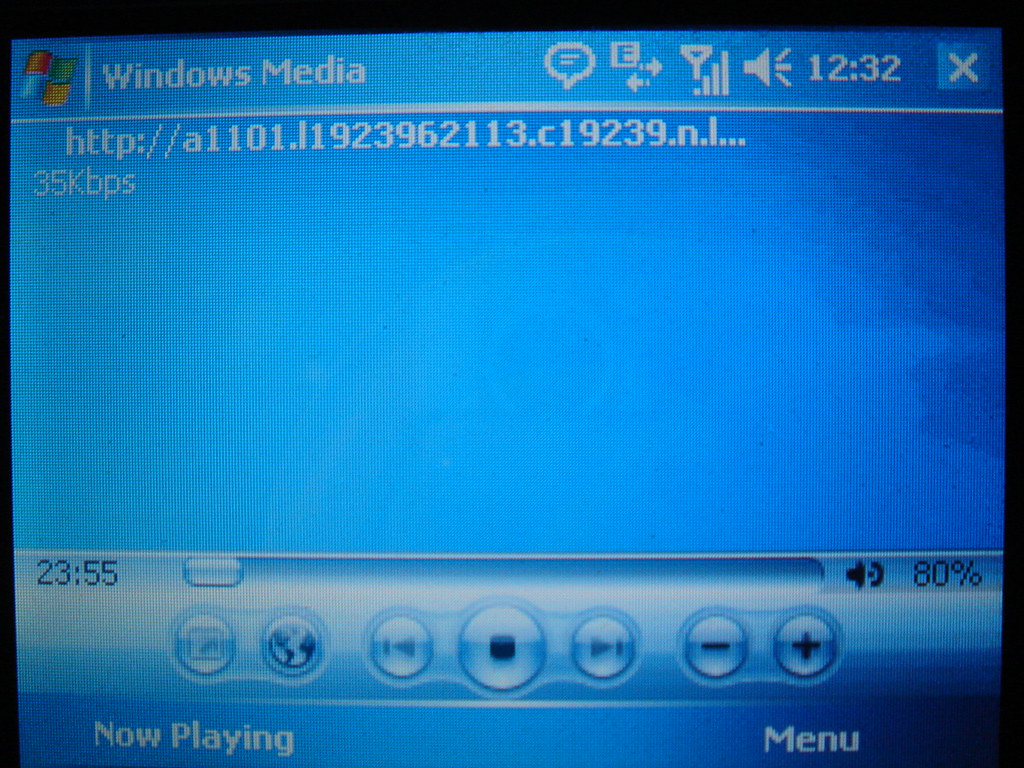
Since you don't have the JavaScript volume controls at your disposal, you may need to adjust your pocket pc volume in addition to the media player volume. If you get an access denied error, you'll have to start the process over again. Have fun and be sure to contact Sirius customer care and request this platform to be supported for subscribers.
Wednesday, April 12, 2006
Tech: How to Set up VPN on a Cingular Wireless HTC 8125 Running Windows Mobile 5
So you just bought a brand new, fancy smart phone from Cingular Wireless that runs Windows Mobile 5.0. It's got everything you need to entertain and stay connected. All you need now is to be able to use it to securely access your corporate email and intranet web documents. If you're saavy enough to have figured out how to configure the network connections in Windows mobile, you may have already seen your phone connect to the VPN server and fail. If this has happened to you, or you are not sure where to start, here's what to do:
- Select Start -> Settings -> Connections -> Connections -> Advanced
- Open Select Networks
- Change the Media Net connection to My ISP.
- Create a new modem called Cingular GPRS APN that uses a Cellular Line (GPRS)
- Select Next and set isp.cingular as the access point for the connection to use
- Set the User name as ISP@CINGULARGPRS.COM, password as CINGULAR1, and leave the domain field blank.
- Select Finish
- Select Edit under My Work Connection
- Select the VPN tab
- Create a new VPN connection by selecting New
- Select Next, and fill in the appropriate fields for User name, Password, and Domain.
- Select Finish.
- From the Network Management Screen, select ok.
- Select Exceptions
- Select Add new URL
This will open the connections screen that will allow you to define connection ordering, intranet URLs needed for the VPN Server, and the VPN server settings.
By default you will most likely see Media Net as the connection used to connect to the Internet. If you are not using a VPN, or you do not require the use of nondefault network ports, this will work fine for you. However, this connection relies on a proxy server, and uses the wrong access point. Instead, do the following:
If My ISP does not exist, create a new connection.
You now have a working Internet connection that can also communicate with VPN servers. Next, you'll want to configure your work connection which includes the VPN server information. Perform the following:
Choose a connection name and the fully qualified hostname of the externally facing VPN server. Choose the appropriate VPN type. If you are using Microsoft products, it will more than likely need to be set to pptp.
Now you have a working VPN connection. The last remaining item, is to create filtering rules so that your email or web client will know what URLs are internal. Perform the following:
You should now be back at the Connections screen.
Here you will want to create wildcarded URLs for all of your internal domains including the domain for your email server, and any web servers you will be accessing. You are now ready to go! Interestingly enough, I was only able to get a VPN connection initially established through the Outlook client and not the Web client. Once the VPN connection had been established however, I could access whatever intranet web documents I wanted. Be sure to set up your web client to use the internal server name (and an associated exception filter) in order for this to work correctly. You are now ready to join the mobile workforce, and check your email from the beach...if that's what you REALLY want to do while you're there. Have fun!
Wednesday, January 11, 2006
Opinion: The Mockery That is Smog Certification...
As I understand it, Smog certification seeks to reduce pollution resulting from motor vehicles by enforcing the following:
1) Catch the worst offenders and force vehicle modification to maintain minimal acceptable emissions standards.
2) To enact manufacturing requirements to meet increasingly tight emissions standards.
What has happened instead is an all-out war against consumers by every level of commercialization and government. Frequently, the worst offenders have an exemption status either because of the vehicle type or the vehicle's age. Moreover, manufactures absolve themselves of responsibility for higher mileage cars and capitalize off of the unecessary repair or replacement of expensive emmissions parts that are in otherwise acceptable working order but cause the test to fail as a result of visual inspection of the engine service light. Cities profit off of the rash of fixit tickets doled out to consumers unable to register their vehicle until unecessary expensive repairs are put in to place, and an entire industry has emerged helping offenders "beat the system". All of this has made a mockery of the Smog certification process itself.
Consider my most recent entry in to this foray. My California registration of my high mileage Infiniti QX4 is late now because dealer diagnostics had determined that my check engine light being illuminated was the result of either a bad sensor or a charcoal canister that needed to be replaced. To insure that the problem is alleviated, all of the sensors and the canister are replaced simultaneously to the tune of $1200.00 including labor. This value alone represents 1/6th the Kelly Blue Book value of the vehicle itself. With the end of the year nearing and the risk of an expired registration ticket looming, I had the work completed.
I then made an appointment at a AAA Car Care Plus Center since I would be able to take care of the registration immediately after. Much to my surprise, the smog check failed. All of the emissions were flawless and well with in the maximum allowable values for CO2, O2, HC, and CO. However, the Ignition timing was off and the engine check light had illuminated in the middle of the test. So, back to the dealer again to have the ignition timing adjusted and root cause analysis for the CEL. It turns out that a chunk of charcoal was stuck in the line, and resulted in an error. Why this only happened during the test and not under the days of normal driving condition prior could not be explained.
Between the time that I had the additional work done and was able to schedule a free retest with AAA, I got a citation from an unmarked police officer. I would now no longer be able to register my car at AAA, and would have to fo to the DMV instead. Not being a moving violation fortunately, the ticket carries no points penalties, but does cost a $10 processing fee and sign-off by either an officer, or a DMV representative.
When I returned to AAA, again having to take time off of work, I was even more surprised when the test failed a second time--this time with the NO2 emissions output under load at 15MPH. Knowing full well that all of the emissions had passed during the initial test, I returned to the dealer to have a look at the original test results. To my amazement, they were two entirely different tests! The first test was an Idle Emission Test, and the second was an ASM Emission test. AAA was unable to explain the discrepancy. Here are the two test results:
I came to find out later that the first test, which does not include NO emissions results, was actually only supposed to be used for cars initially registered in rural areas or for all-wheel drive vehicles that cannot disengage the awd to run on the dyno machine. Not a single person at AAA was able to tell me why the first test would have been run for my 4x4. But, I was now faced with the fact that my car still did not pass the smog test. I was offered up three reasons for this failure. The first was that the catalytic converter was bad, Second that the catalytic converter was not hot enough, and third that the O2 sensor was misbehaving.
So, I asked around about what could possibly be done to rectify the situation. My service advisor whispered that I should dump techron in to the trank and drive it "like hell", then take it in for testing while hot. The AAA office seemed to think that a new catalytic converter was in order. A third helpful person indicated there were "places to go" to get the car to pass smog, but that they were "expensive". I found it hard to believe that a 1997 high end luxury car should require any of these temporary work arounds, or that the certification process was really a dependable means of enforcement. I have heard of plenty of drivers removing the catalytic converter entirely, replacing it with a test pipe, and still somehow passing emissions. Yet, here I was with a completely street legal car, with $1200 in a new emissions part, and I still couldn't get a definite answer why the car failed or how to fix it.
So, I went the techron route, and drove it like hell, hoping that I was not actually doing permanent damage to the engine. Since my reg was expired, I had no time to waste. The techron canister indicated that it should be used on an empty tank, and then filled full and run through a complete tank of gas. I decided instead to use the bottle on half a tank of gas, and smog test the car near my office after driving the freeway with the overdrive turned off. At each stop, I would shift in to neutral and redline the car during the entire duration of the light. Once at the test station, I turned the overdrive off and left the car in autmatic awd in hopes that the NO test would be overlooked alltogether again by avoiding the dyno. With the car still hot, here are how the test results turned out 1 day, 1 bottle of techron, and 30 miles later (with the awd correctly disengaged):
The significance of this change simply cannot be ignored. When confronted with the vast difference in values, AAA deferred to an O2 sensor that was about to go bad and had not yet thrown an engine code. I'm not so convinced. Techron cleans the injectors and the compustion chamber and NO is directly related to the temperature of compustion. Either way, the entire process is unecessarily complex, unreliable, burdonsome, easy to bypass or abuse, and negatively affects that time and pocketbooks of each and every driver. I believe that more pressure needs to be put on manufactures to stand by their emissions parts for the life of the vehicle, and that tighter restrictions need to made on those vehicles that pollute the most. Smogging in theory is good for the environment, but embarassing in execution, and severely lacking in affectiveness. Ongoing certification has had a questionable affect on overall pollutants, and has fostered an industry that takes advantage of consumers by forcing them to buy expensive, unecessary parts, or to help cheat the system entirely.
1) Catch the worst offenders and force vehicle modification to maintain minimal acceptable emissions standards.
2) To enact manufacturing requirements to meet increasingly tight emissions standards.
What has happened instead is an all-out war against consumers by every level of commercialization and government. Frequently, the worst offenders have an exemption status either because of the vehicle type or the vehicle's age. Moreover, manufactures absolve themselves of responsibility for higher mileage cars and capitalize off of the unecessary repair or replacement of expensive emmissions parts that are in otherwise acceptable working order but cause the test to fail as a result of visual inspection of the engine service light. Cities profit off of the rash of fixit tickets doled out to consumers unable to register their vehicle until unecessary expensive repairs are put in to place, and an entire industry has emerged helping offenders "beat the system". All of this has made a mockery of the Smog certification process itself.
Consider my most recent entry in to this foray. My California registration of my high mileage Infiniti QX4 is late now because dealer diagnostics had determined that my check engine light being illuminated was the result of either a bad sensor or a charcoal canister that needed to be replaced. To insure that the problem is alleviated, all of the sensors and the canister are replaced simultaneously to the tune of $1200.00 including labor. This value alone represents 1/6th the Kelly Blue Book value of the vehicle itself. With the end of the year nearing and the risk of an expired registration ticket looming, I had the work completed.
I then made an appointment at a AAA Car Care Plus Center since I would be able to take care of the registration immediately after. Much to my surprise, the smog check failed. All of the emissions were flawless and well with in the maximum allowable values for CO2, O2, HC, and CO. However, the Ignition timing was off and the engine check light had illuminated in the middle of the test. So, back to the dealer again to have the ignition timing adjusted and root cause analysis for the CEL. It turns out that a chunk of charcoal was stuck in the line, and resulted in an error. Why this only happened during the test and not under the days of normal driving condition prior could not be explained.
Between the time that I had the additional work done and was able to schedule a free retest with AAA, I got a citation from an unmarked police officer. I would now no longer be able to register my car at AAA, and would have to fo to the DMV instead. Not being a moving violation fortunately, the ticket carries no points penalties, but does cost a $10 processing fee and sign-off by either an officer, or a DMV representative.
When I returned to AAA, again having to take time off of work, I was even more surprised when the test failed a second time--this time with the NO2 emissions output under load at 15MPH. Knowing full well that all of the emissions had passed during the initial test, I returned to the dealer to have a look at the original test results. To my amazement, they were two entirely different tests! The first test was an Idle Emission Test, and the second was an ASM Emission test. AAA was unable to explain the discrepancy. Here are the two test results:
| %CO2 | %O2 | HC (PPM) | CO% | |||||||
| Test | RPM | MEAS | MEAS | MAX | AVE | MEAS | MAX | AVE | MEAS | Results |
| Idle | 775 | 14.70 | 0.4 | 100 | 17 | 10 | 1.00 | 0.00 | 0.00 | PASS |
| 2500 RPM | 2387 | 14.70 | 0.2 | 170 | 13 | 11 | 1.00 | 0.10 | 0.07 | PASS |
| %CO2 | %O2 | HC (PPM) | CO% | NO (PPM) | |||||||||
| Test | RPM | MEAS | MEAS | MAX | AVE | MEAS | MAX | AVE | MEAS | MAX | AVE | MEAS | Results |
| 15 MPH | 1837 | 14.90 | 0.05 | 47 | 8 | 12 | 0.60 | 0.02 | 0.07 | 494 | 88 | 0635 | FAIL |
| 25 MPH | 1900 | 14.90 | 0.04 | 31 | 6 | 12 | 0.73 | 0.02 | 0.08 | 747 | 82 | 0580 | PASS |
I came to find out later that the first test, which does not include NO emissions results, was actually only supposed to be used for cars initially registered in rural areas or for all-wheel drive vehicles that cannot disengage the awd to run on the dyno machine. Not a single person at AAA was able to tell me why the first test would have been run for my 4x4. But, I was now faced with the fact that my car still did not pass the smog test. I was offered up three reasons for this failure. The first was that the catalytic converter was bad, Second that the catalytic converter was not hot enough, and third that the O2 sensor was misbehaving.
So, I asked around about what could possibly be done to rectify the situation. My service advisor whispered that I should dump techron in to the trank and drive it "like hell", then take it in for testing while hot. The AAA office seemed to think that a new catalytic converter was in order. A third helpful person indicated there were "places to go" to get the car to pass smog, but that they were "expensive". I found it hard to believe that a 1997 high end luxury car should require any of these temporary work arounds, or that the certification process was really a dependable means of enforcement. I have heard of plenty of drivers removing the catalytic converter entirely, replacing it with a test pipe, and still somehow passing emissions. Yet, here I was with a completely street legal car, with $1200 in a new emissions part, and I still couldn't get a definite answer why the car failed or how to fix it.
So, I went the techron route, and drove it like hell, hoping that I was not actually doing permanent damage to the engine. Since my reg was expired, I had no time to waste. The techron canister indicated that it should be used on an empty tank, and then filled full and run through a complete tank of gas. I decided instead to use the bottle on half a tank of gas, and smog test the car near my office after driving the freeway with the overdrive turned off. At each stop, I would shift in to neutral and redline the car during the entire duration of the light. Once at the test station, I turned the overdrive off and left the car in autmatic awd in hopes that the NO test would be overlooked alltogether again by avoiding the dyno. With the car still hot, here are how the test results turned out 1 day, 1 bottle of techron, and 30 miles later (with the awd correctly disengaged):
| %CO2 | %O2 | HC (PPM) | CO% | NO (PPM) | |||||||||
| Test | RPM | MEAS | MEAS | MAX | AVE | MEAS | MAX | AVE | MEAS | MAX | AVE | MEAS | Results |
| 15 MPH | 2432 | 14.7 | 0.00 | 47 | 8 | 18 | 0.60 | 0.02 | 0.15 | 494 | 88 | 317 | PASS |
| 25 MPH | 2335 | 14.7 | 0.0 | 31 | 6 | 11 | 0.73 | 0.02 | 0.11 | 747 | 82 | 401 | PASS |
The significance of this change simply cannot be ignored. When confronted with the vast difference in values, AAA deferred to an O2 sensor that was about to go bad and had not yet thrown an engine code. I'm not so convinced. Techron cleans the injectors and the compustion chamber and NO is directly related to the temperature of compustion. Either way, the entire process is unecessarily complex, unreliable, burdonsome, easy to bypass or abuse, and negatively affects that time and pocketbooks of each and every driver. I believe that more pressure needs to be put on manufactures to stand by their emissions parts for the life of the vehicle, and that tighter restrictions need to made on those vehicles that pollute the most. Smogging in theory is good for the environment, but embarassing in execution, and severely lacking in affectiveness. Ongoing certification has had a questionable affect on overall pollutants, and has fostered an industry that takes advantage of consumers by forcing them to buy expensive, unecessary parts, or to help cheat the system entirely.
Subscribe to:
Posts (Atom)